EBF — Elliptical Basis Functions
EBF is an interpolation library that fits smooth surfaces through scattered data points. It generalizes the well-known Radial Basis Function (RBF) approach by giving each interpolation node its own stretchable, rotatable ellipsoidal influence zone — so the model can adapt to data that varies more quickly in some directions than others.
Built on TensorFlow 2, EBF is designed for engineering datasets: compressor maps, geotechnical measurements, aerodynamic surfaces, and similar problems where you have a moderate number of irregularly spaced measurements and need a smooth, continuous prediction surface.
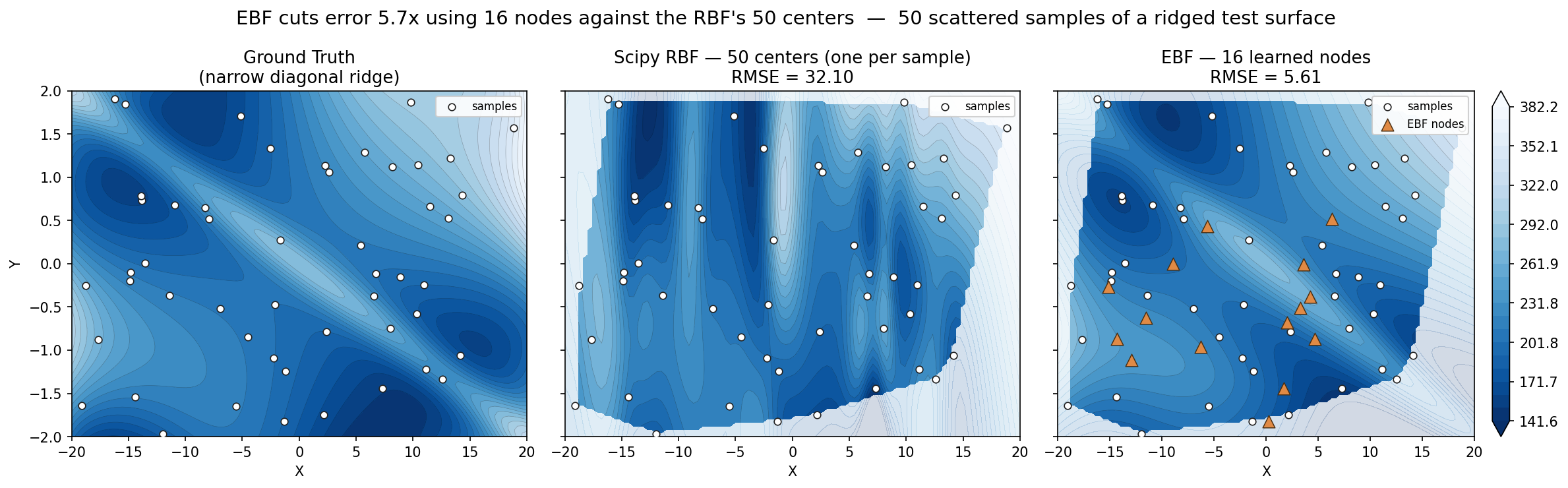
50 scattered samples of a surface with a narrow diagonal ridge. Scipy's RBF places a center at every sample (50 of them) and still rings around the ridge — RMSE 32.10. EBF uses 16 learned nodes and follows it — RMSE 5.61.
What Makes It Different
A conventional RBF measures distance from every center with one shared, circular metric, so a center can only ever cover a round patch. An EBF node carries its own positive-definite matrix, and the optimizer is free to stretch and rotate it during training.
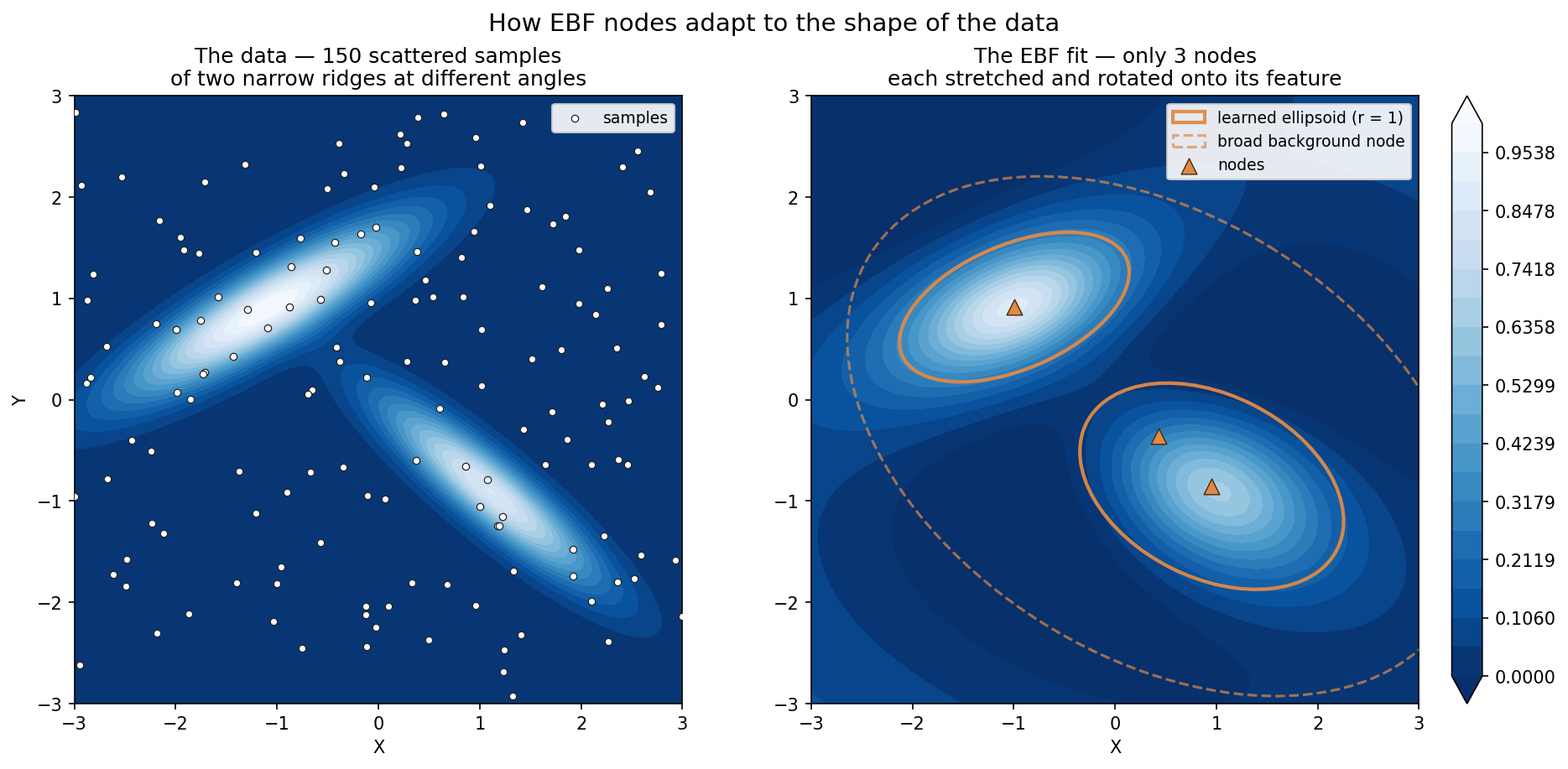
Three nodes fit to two narrow ridges at +30° and −40°. Two nodes elongate and turn onto a ridge each; the third stays broad and carries the background. Nothing instructs the model to do this — it falls out of minimizing fit error.
Why this matters more as dimensions grow
RBF interpolation carries an assumption inherited from the spatial problems it was invented for: that the input space is Euclidean, so distance means something. For latitude and longitude that holds. But when your axes are speed, power, temperature, pressure, and price, there is no common unit and therefore no natural notion of distance — how far is 10 kPa from 3 °C? Standardizing each axis to unit variance (which EBF does automatically) supplies a default answer, but it is a guess, not a physical fact.
The per-node ellipsoid is that guess made learnable. Because each matrix is full and symmetric rather than a per-axis scaling, it can rotate as well as stretch — capturing that two variables act together, not merely that one matters more than another.
The examples are 2-D; the method is not
Two inputs and one output are simply what a contour plot can display. Fitting,
prediction, evaluation grids, and lookup-table export are all dimension-agnostic —
only contour_plot_2d and summary_plot_3d require exactly two inputs. Above that,
use correlation_plot and residual_plot to judge fit quality, and sweep two
variables at a time with eval_grid to view slices.
Installation
The example scripts additionally need pandas and openpyxl:
For development work on EBF itself:
Quickstart
import numpy as np
import ebf

# Create some 1D data
X = np.linspace(0, 2 * np.pi, 30).reshape(-1, 1)
y = np.sin(X).ravel()

# Fit a model
model = ebf.EBF(n_nodes=8)
model.fit(X, y, steps=5000)

# Predict at new points
X_new = np.linspace(0, 2 * np.pi, 200).reshape(-1, 1)
y_pred = model.predict(X_new)
Key Features
- Ellipsoidal nodes — each node learns its own directional influence, unlike standard RBF which uses fixed spherical distances
- 12 basis functions — from multiquadric and Gaussian to Matern kernels; see the Basis Functions reference
- Automatic data scaling — inputs and outputs are standardized internally so you don't need to normalize your data
- Noise-robust training — optional Huber loss reduces outlier influence, and Tukey biweight loss rejects gross outliers entirely; both self-calibrate to the residual noise floor
- Simple API —
fit(),predict(),get_nodes(),save(),load() - Save and reload — checkpoint your trained model and restore it later
- Visualization utilities — correlation plots, 2-D contour maps, n-dimensional evaluation grids, and CSV/NPZ lookup-table export
Next Steps
- How the Algorithm Works — a plain-English explanation of what EBF does under the hood
- Basis Functions — gallery and reference for all available basis functions
- Loss Types — handling noise and outliers with Huber and Tukey losses
- Visualization Utilities — correlation plots, contour maps, evaluation grids, and lookup-table export
- API Reference — full parameter documentation
- RBF vs EBF — the headline comparison, and why it works
- Compressor Map Example — a complete walkthrough fitting a 2D engineering dataset